Feedback and coachingTrust and accountabilityPower and influence
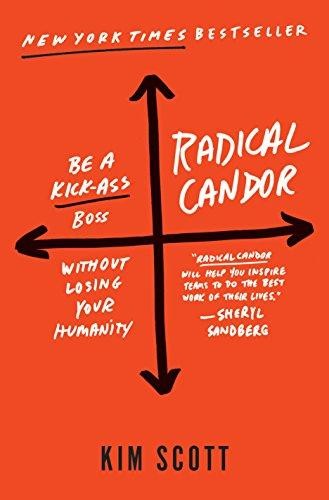
Radical Candor
Be a Kick-Ass Boss Without Losing Your Humanity
Kim Scott
Most managers fail by being too nice, not too harsh. The kind thing is usually the honest thing, said soon.
Overview
My interpretation
Why it's on my shelf
I coach engineers and I coach kids, and the hardest part of both is the same: telling someone the truth in a way they can use. Scott gave me a simple map for checking which mistake I’m making.
Book's argument
What this book is about
Good leadership comes from caring personally about people while challenging them directly. Scott maps feedback on those two dimensions and shows how falling short on either one produces common failures, and she argues that a boss’s job is to build relationships that make honest guidance possible in both directions.
Book's argument
The four quadrants
- 1Radical CandorCare personally and challenge directly, at the same time.
- 2Obnoxious AggressionChallenge without care: honest, but it damages the relationship.
- 3Ruinous EmpathyCare without challenge: kind in the moment, harmful over time.
- 4Manipulative InsincerityNeither care nor challenge: political, and the worst of the four.
Key Ideas
Key ideas
Book's argument
01Two dimensions, four quadrants
Care personally and challenge directly; missing one produces obnoxious aggression, ruinous empathy or manipulative insincerity.
Caveat The quadrants describe behaviour in a moment, not fixed types of people.
Book's argument
02Ruinous empathy is common
The most frequent failure is being so nice that people never hear the criticism they need.
Caveat Avoiding feedback can also come from overload or unclear expectations, not only from niceness.
On a team A manager who softens every review may leave someone surprised by a poor performance rating.
Book's argument
03Ask for criticism first
Before giving feedback, a leader should ask for it and show they can receive it well.
Caveat Power differences mean reports may still hold back, however sincerely the boss asks.
Book's argument
04Praise in public, criticize in private
Specific, sincere praise and private, timely criticism keep feedback useful rather than performative.
Caveat Some people prefer private praise; norms vary by person and culture.
Book's argument
05Growth paths differ
Some people want steep growth and others stability, and both deserve support suited to where they are.
Caveat Labels for people’s growth trajectories can harden into a fixed category if not revisited.
My Notes
My application
How I apply it
- I ask for criticism before I give it, and I try to reward it visibly when I get it.
- When I notice I’m avoiding a hard conversation “to be kind”, I name it: ruinous empathy, and the kind thing is to have it now.
- I praise in public with specifics, and criticize in private and soon.
- On the court, care personally is the brotherhood and challenge directly is the discipline. Kids can tell immediately when you have only one of them.
My interpretation
Where I agree
The two-axis model is simple enough to use in the moment, which is rare. Naming ruinous empathy as the most common failure is the book’s biggest gift: most managers fail by being too nice, not too harsh.
My critique
Where I push back
It is mostly anecdote from Silicon Valley giants, and “radical candor” is easy to misuse as cover for being a jerk, which the book itself warns about but can’t prevent. Candor also lands differently across cultures, power gaps and identities; the same words from a manager and from a peer are not the same message.
My interpretation
My reflections
Feedback is a gift
Caring personally while challenging directly builds stronger teams and better outcomes. Coaching kids made it obvious: they can tell in seconds whether you believe in them, and only then will they hear the correction.
Takeaways
My interpretation
Takeaways
- Care personally and challenge directly, together.
- Ruinous empathy is the most common failure.
- Ask for criticism first; earn the right to give it.
- Praise specifically and publicly; criticize privately and soon.
My application
Questions for your team
- When did you last ask your team for criticism of you, and what did you do with it?
- Which piece of feedback have you been sitting on for more than a week?
- Is your praise specific enough that the person could repeat what they did?
- Who on the team never gets challenged, and why?
- Does feedback flow up and sideways, or only down?
My interpretation
Read it with
Read it with Drive for why people need autonomy, and with The 48 Laws of Power as its opposite: Greene maps manipulative insincerity in detail.
My critique
Who should skip it
Skip it if you already give clear, kind feedback every week. It misleads anyone who reads “challenge directly” without the “care personally” half.
Related Books
Related books
- Feedback and coachingDriveDaniel H. Pink
My interpretation
Autonomy without candor drifts. I give people control over the how, and Scott’s care-and-challenge feedback is how they find out whether it’s working.
- Power and influenceThe 48 Laws of PowerRobert Greene
My critique
These two argue with each other. Greene maps manipulative insincerity in detail; Scott names it the worst quadrant. I read Greene to recognize the moves and Scott to know what to do instead.
Read, borrow or buy
- The author’s book page Kim Scott (Radical Candor) · print · buy · link checked Oct 22, 2026
Drafted with AI assistance from the book and its published material, edited and published by me. Nothing here quotes the book at length; get the book itself for the real thing. Cover image: Open Library. Ads & privacy.