Engineering excellence
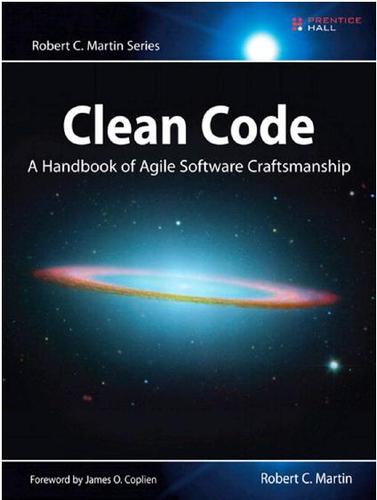
Clean Code
A Handbook of Agile Software Craftsmanship
Robert C. Martin
Clean code is a team agreement, not a personal virtue. Put the agreement in CI and stop arguing about it in review.
Overview
My interpretation
Why it's on my shelf
Clean Code is the book that gave a generation of engineers, me included, a shared language for code quality. I keep it on the shelf less as a rulebook and more as a reminder that readable code is a kindness to the next person, and now to the next agent, that has to change it.
Book's argument
What this book is about
Martin argues that code is read far more often than it is written, so the main cost of software is understanding and changing it. Clean code is code a reader can follow without effort: well-named, small, tested and free of surprises. Writing it is a discipline of continuous small improvements rather than occasional big rewrites.
Book's argument
The craft, chapter by chapter
- 1Meaningful namesNames should reveal intent, so a reader never has to decode them.
- 2Small functionsA function should do one thing, at one level of abstraction, with few arguments.
- 3CommentsPrefer code that explains itself; a comment often marks a failure to express intent in code.
- 4FormattingConsistent layout is communication; a team should agree on one style and follow it.
- 5Error handlingUse exceptions rather than error codes, and don’t return or pass null.
- 6Unit testsTests deserve the same care as production code: fast, independent, repeatable, self-validating, timely.
- 7ClassesKeep classes small, with a single reason to change.
- 8The Boy Scout RuleLeave the code a little cleaner than you found it, every time.
Key Ideas
Key ideas
Book's argument
01Code is read more than written
Most of the time spent on code goes into reading and understanding it, so optimizing for the reader pays off.
Caveat How much this matters depends on the code’s lifespan; throwaway scripts don’t need the same care.
On a team A service that many teams touch gets cheaper to change every time someone improves its names.
Book's argument
02Functions should do one thing
Small functions at a single level of abstraction are easier to name, test and understand.
Caveat Pushed too far, tiny functions fragment logic and make flow harder to follow.
Book's argument
03Comments are often a smell
Prefer expressing intent in code; comments drift out of date and can hide unclear code.
Caveat Comments that explain why, or record a decision, remain valuable and are often missing.
Book's argument
04Tests are first-class code
Tests should be clean, fast and independent, because a suite nobody trusts gets ignored.
Caveat Test style is also contested; the book’s preferences aren’t the only workable approach.
On a team A team with readable tests uses them as documentation for how the system is meant to behave.
Book's argument
05Leave it cleaner than you found it
Continuous small improvements keep a codebase healthy without big rewrites.
Caveat Opportunistic cleanup can bloat changes; keep it small and reviewable.
My Notes
My application
How I apply it
- I treat readability as a team standard, not a matter of taste: we agree on conventions once and let linters and formatters enforce them, so review time goes to design, not style.
- “CI lands the work” is the rule my agent fleet runs under, and clean code is what makes that safe: small, well-tested changes are the only kind a required check can judge.
- I ask for the Boy Scout Rule in every change: leave the touched code a little better, and keep the cleanup in the same small PR.
- When an agent writes code, I hold it to the same bar as a person. Names, small functions and tests are what let a reviewer, human or AI, actually review it.
My interpretation
Where I agree
The core claim is right and has aged well: code is read far more than it is written, and the cost of a codebase is the cost of understanding it. Small, well-named units and tests you can trust are still the foundation of a team that moves fast safely.
My critique
Where I push back
The examples are dated and Java-centric, and some rules are contested in practice. Very small functions can scatter logic across files and make code harder to follow, not easier, and a blanket suspicion of comments undersells comments that explain why. Followed as dogma, the book produces cleverness in the name of cleanliness; it works best as a set of defaults a team adapts and agrees on.
My interpretation
My reflections
Readable code is a kindness to the next reader
The next person to change this code might be a teammate, a new hire, or an agent working from a fresh checkout. Names that reveal intent, small functions and tests you can read are what let any of them change it safely. That's why I hold agent-written code to the same bar as human code.
Takeaways
My interpretation
Takeaways
- Write for the reader; that reader is now often an agent too.
- Agree on standards once, then automate them.
- Small, safe improvements beat big rewrites.
- Treat test code as production code.
- Rules are defaults, not dogma.
My application
Questions for your team
- Could a new engineer explain what this module does after ten minutes of reading?
- Which of our naming or style arguments could a tool settle for us?
- When did we last leave code cleaner than we found it, in a change that wasn’t a dedicated refactor?
- Are our tests clear enough to read as documentation?
- Where are we tolerating a function nobody wants to touch, and why?
My interpretation
Read it with
Read it with Extreme Programming Explained: Clean Code is the craft inside the practices; XP is the system that makes the craft routine.
My critique
Who should skip it
Skip it if you want current, language-specific guidance; it’s a 2008 book with Java examples. It misleads teams that turn its heuristics into hard rules and fight about function length in review.
Related Books
Related books
- Engineering excellenceExtreme Programming ExplainedKent Beck and Cynthia Andres
My interpretation
Clean Code is the craft inside XP’s practices. Refactoring, simple design and tests only work if the code is readable enough to change safely.
- Delivery performanceAccelerateNicole Forsgren, Jez Humble and Gene Kim
My critique
They disagree about where quality comes from. Martin puts it in the individual’s craft; Accelerate puts it in the system of capabilities. I side with the system, then use craft as the standard the system enforces.
Read, borrow or buy
- Publisher page InformIT (Pearson) · print · buy · link checked Oct 22, 2026
Drafted with AI assistance from the book and its published material, edited and published by me. Nothing here quotes the book at length; get the book itself for the real thing. Cover image: Open Library. Ads & privacy.