Trust and accountabilityTeam culture
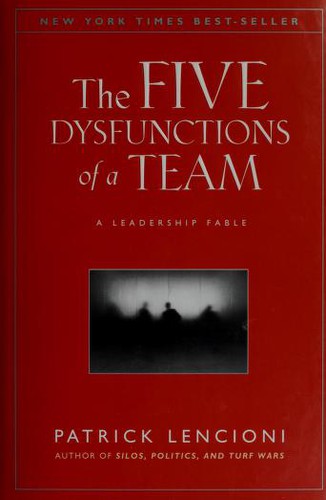
The Five Dysfunctions of a Team
A Leadership Fable
Patrick Lencioni
Accountability that isn’t built into the system doesn’t exist. Neither does trust that the leader doesn’t go first on.
Overview
My interpretation
Why it's on my shelf
It is the simplest model of team failure I know, and the most useful. I use it with engineering teams, with leadership teams and on the basketball court, because the pyramid holds in all three.
Book's argument
What this book is about
Told as a fable about a new CEO and her executive team, the book argues that teams fail through five connected dysfunctions: absence of trust, fear of conflict, lack of commitment, avoidance of accountability and inattention to results. Each builds on the one beneath it, so the work starts with trust that lets people be open about their weaknesses.
Book's argument
The five dysfunctions, from the bottom up
- 1Absence of trustPeople won’t admit mistakes or weaknesses, so they spend energy protecting themselves.
- 2Fear of conflictWithout trust, teams avoid honest debate and settle for artificial harmony.
- 3Lack of commitmentWithout debate, people never truly buy in, even when they nod along.
- 4Avoidance of accountabilityWithout commitment, peers won’t call each other on falling short.
- 5Inattention to resultsWithout accountability, individual status and ego replace collective results.
Key Ideas
Key ideas
Book's argument
01Trust means vulnerability
The trust that matters is people being willing to admit mistakes, weaknesses and the need for help without fear.
Caveat Psychological safety depends on the whole environment, not only on individual willingness to be vulnerable.
Book's argument
02Conflict is productive
Teams with trust can argue openly about ideas; teams without it settle for artificial harmony and hidden disagreement.
Caveat The line between healthy debate and personal conflict needs to be actively protected.
On a team A design review where nobody disagrees may be a warning sign, not a success.
Book's argument
03Commitment without consensus
People can commit to a decision they argued against if they were heard and the decision is clear.
Caveat It needs clear decision owners; otherwise disagreement simply resurfaces later.
Book's argument
04Peers hold each other accountable
The strongest accountability comes from teammates, not only from the leader.
Caveat Peer accountability can turn punitive without the trust layer underneath it.
Book's argument
05Collective results come first
Team results have to matter more than individual status or the goals of each member’s own department.
Caveat Incentives that reward individuals can work directly against this.
My Notes
My application
How I apply it
- When accountability is weak, I look one level down first: is there real commitment, and was there real debate before it?
- I go first on vulnerability: admitting what I got wrong, in public, makes it safe for others.
- My agent fleet taught me the top of the pyramid. Our scoreboard found only about a quarter of agent PRs were reviewed before merging. Nobody was hiding anything; accountability simply wasn’t built into the system. Making review a required check fixed it.
- With the teams I coach, “brotherhood” is the trust layer. Without it, hunger and discipline turn into blame.
My interpretation
Where I agree
The ordering is the insight: you can’t fix accountability by demanding it, because it rests on commitment, conflict and trust beneath it. The fable format makes it stick in a way a framework list wouldn’t.
My critique
Where I push back
It is a fable, not research, and the pyramid is a clean story laid over messy reality. It underplays structural causes (bad incentives, unclear ownership, overloaded teams) and can push leaders to treat a systems problem as a personality problem. Its executive-team setting also maps imperfectly to engineering teams with on-call, product pressure and remote members.
My interpretation
My reflections
Accountability has to be built in
When we counted, only about a quarter of my agent fleet’s pull requests had been reviewed before they merged. Nobody was hiding anything; the system simply let work land without the check. Lencioni puts accountability near the top of the pyramid, and agents taught me that it has to be designed into the pipeline, not requested.
Trust is the foundation
Without trust, teams spend their energy managing perceptions instead of solving problems. I have watched good engineers go quiet in reviews because admitting a gap felt riskier than shipping one. The fix starts with the leader saying “I don’t know” first, and meaning it.
Takeaways
My interpretation
Takeaways
- Trust is the foundation, and it means vulnerability.
- Healthy conflict comes before real commitment.
- The best accountability is peer to peer.
- Accountability that isn’t built into the system doesn’t exist.
My application
Questions for your team
- When did someone on this team last say “I was wrong” in a meeting?
- Do our meetings ever have real disagreement, or does it happen afterwards in private?
- After a decision, can everyone state it the same way?
- Who calls out a peer who misses a commitment: the peer, or only me?
- Are we measured on team results, or does everyone have their own scoreboard?
My interpretation
Read it with
Read it with Peopleware for the conditions that let teams jell, and Radical Candor for how to have the conflict this book says you need.
My critique
Who should skip it
Skip it if you need evidence; it offers none. It misleads when used to blame individuals for problems the org chart or incentives created.
Related Books
Related books
- Trust and accountabilityPeoplewareTom DeMarco and Timothy Lister
My interpretation
Peopleware tells me what lets a team jell; Lencioni tells me what’s missing when it doesn’t. Read together, they say the same thing from two sides: results come from the human conditions, not the process.
- Trust and accountabilityAn Elegant PuzzleWill Larson
My critique
A tension worth holding: Lencioni treats team failure as behavior, Larson as structure. When accountability is missing I check both, starting with the system, because a structural problem looks like a people problem from the inside.
- Power and influenceThe 48 Laws of PowerRobert Greene
My critique
Greene’s tactics are a recipe for Lencioni’s base dysfunction. Concealing intentions and guarding position destroy the trust everything else is built on.


Read, borrow or buy
- Publisher page Wiley (Jossey-Bass) · print · buy · link checked Oct 22, 2026
Drafted with AI assistance from the book and its published material, edited and published by me. Nothing here quotes the book at length; get the book itself for the real thing. Cover image: Open Library. Ads & privacy.