Delivery performanceEngineering excellence
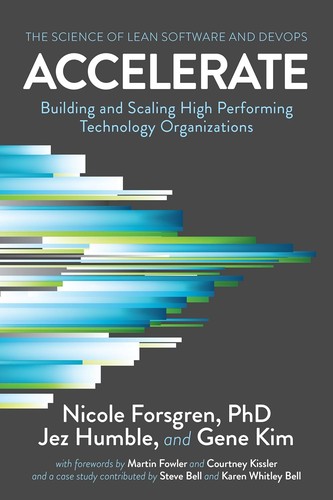
Accelerate
The Science of Lean Software and DevOps: Building and Scaling High Performing Technology Organizations
Nicole Forsgren, Jez Humble and Gene Kim
Measure the system, not the people. Four numbers, recounted honestly, tell you more than any status meeting.
Overview
My interpretation
Why it's on my shelf
Accelerate is the book I hand people who think speed and quality are a trade-off. It turned delivery from opinion into something you can measure, and it shaped how I think about running both engineering teams and an agent fleet: measure the system honestly, then improve the capabilities that move the numbers.
Book's argument
What this book is about
Drawing on several years of State of DevOps survey research, the authors argue that software delivery performance can be measured with four metrics (deployment frequency, lead time, time to restore and change failure rate) and that high performers are better on speed and stability at the same time. They identify a set of technical, process, management and cultural capabilities that predict that performance, and link it to organizational outcomes.
Book's argument
Four key metrics, and the capabilities behind them
- 1Deployment frequencyHow often the team releases to production.
- 2Lead time for changesHow long from code committed to code running in production.
- 3Time to restore serviceHow quickly the team recovers when something breaks.
- 4Change failure rateWhat share of changes cause a failure that needs fixing.
- 5Continuous deliveryVersion control, deployment automation, trunk-based development, test automation and shifting security left.
- 6ArchitectureLoosely coupled systems and teams that can test and deploy independently.
- 7Product and processSmall batches, customer feedback, visible work and room to experiment.
- 8Lean management and monitoringLightweight change approval, monitoring, WIP limits and visual management.
- 9CultureA generative, high-trust culture where information flows and failure leads to learning.
Key Ideas
Key ideas
Book's argument
01Speed and stability aren’t a trade-off
High performers deploy more often and also fail less and recover faster.
Caveat Based on survey data; it shows association across teams, not a guaranteed result for yours.
On a team A team that moves to small, frequent releases usually finds each release less risky, not more.
Book's argument
02Four metrics capture delivery performance
Deployment frequency, lead time, time to restore and change failure rate together describe throughput and stability.
Caveat Any metric can be gamed when it becomes a target; they describe the system, not people.
Book's argument
03Capabilities drive performance
Practices like trunk-based development, test automation and loosely coupled architecture predict better delivery.
Caveat The causal claims depend on the research model, which has its critics.
Book's argument
04Culture is measurable and changeable
A generative, high-trust culture, in Westrum’s sense, predicts better delivery and outcomes.
Caveat Culture surveys are self-reported and sensitive to how safe people feel answering them.
Book's argument
05Heavyweight change approval doesn’t help
External approval boards slow delivery without improving stability; peer review and automation do better.
Caveat Regulated environments may still require formal approvals; the point is to make them lightweight.
My Notes
My application
How I apply it
- Re-establishing weekly releases at Disney Entertainment & ESPN’s Watch Experiences was an Accelerate move: smaller batches, more frequent deploys, less risk per change.
- “Measured, never typed” is a rule in my operating model: the fleet’s numbers are recounted nightly by a deterministic script, and CI fails if the page drifts from the data. That’s Accelerate’s instinct applied to AI agents.
- Measuring honestly is how I found that only about a quarter of agent PRs were reviewed before merging. The fix was a capability, not a pep talk: review became a required check.
- I use the four metrics to talk about the system with leaders, never to rank individual engineers.
My interpretation
Where I agree
The central finding has held up in my experience: the teams that ship more often also break less, because small batches and fast feedback reduce risk. Treating culture as a capability you can build, alongside automation and architecture, is the book’s most useful idea for leaders.
My critique
Where I push back
The research is survey-based and self-reported, and the claims about what predicts performance rest on statistical modeling that critics have questioned; correlation does a lot of work in the book. The four metrics are also easy to game once they become targets: deploy trivial changes, redefine “failure”, shrink “restore”. Used as a leaderboard, they stop measuring anything.
My interpretation
My reflections
Counting found the gap
When I started recounting my agent fleet's numbers every night, the uncomfortable one was that only about a quarter of agent pull requests were reviewed before they merged. The fix wasn't a reminder; it was a capability: review became a required check. Accelerate's lesson, applied to AI.
Measure the system, not the people
Four honest numbers (how often we deploy, how long a change takes, how often it breaks, how fast we recover) tell me more about a team than any status meeting. The moment they become targets for individuals, they stop meaning anything, so I use them only to talk about the system.
Takeaways
My interpretation
Takeaways
- Speed and stability go together; small batches are how.
- Measure the delivery system with four honest numbers.
- Capabilities move the numbers; targets just distort them.
- Culture is a capability you can build.
- Never turn the metrics into a ranking of people.
My application
Questions for your team
- How often do we deploy, and what stops us from deploying more often?
- How long does a one-line change take to reach production?
- When production breaks, how long until users are fine again?
- What share of our changes cause an incident or a rollback?
- Which approval step adds delay without adding safety?
- Do people bring bad news early, or does it surface late?
My interpretation
Read it with
Read it with Extreme Programming Explained: XP describes the practices; Accelerate shows the evidence that they pay off at scale.
My critique
Who should skip it
Skip it if you want a how-to; it’s a research summary, and the practical detail lives in Continuous Delivery and the DORA reports. It misleads leaders who adopt the metrics as targets without building the capabilities behind them.
Related Books
Related books
- Engineering excellenceExtreme Programming ExplainedKent Beck and Cynthia Andres
My interpretation
XP described the practices: small releases, tests first, continuous integration. Accelerate brought the evidence that they pay off at scale. I read Beck for the how and Forsgren for the proof.
- Delivery performanceAn Elegant PuzzleWill Larson
My interpretation
Larson tells me what state a team is in; Accelerate gives me four numbers to check whether my fix is working. Together they turn org design from opinion into an experiment.
- Delivery performanceClean CodeRobert C. Martin
My critique
They disagree about where quality comes from. Martin puts it in the individual’s craft; Accelerate puts it in the system of capabilities. I side with the system, then use craft as the standard the system enforces.

Read, borrow or buy
- Publisher page IT Revolution · print · buy · link checked Oct 22, 2026
Drafted with AI assistance from the book and its published material, edited and published by me. Nothing here quotes the book at length; get the book itself for the real thing. Cover image: Open Library. Ads & privacy.