MotivationFeedback and coaching
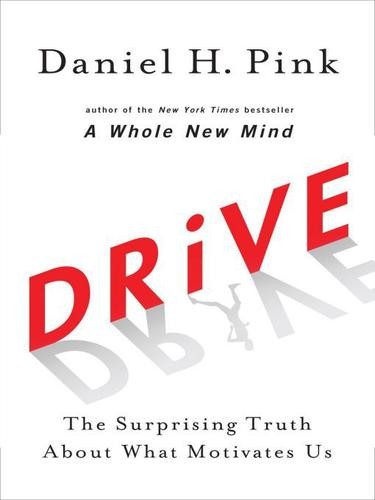
Drive
The Surprising Truth About What Motivates Us
Daniel H. Pink
Autonomy works on a leash: clear boundaries, real freedom inside them. True for engineers, true for agents.
Overview
My interpretation
Why it's on my shelf
Drive gave me the vocabulary for something I saw in every team I led: the best engineers want control, growth and a reason, not a bonus scheme. It also turned out to describe how I design autonomy for agents.
Book's argument
What this book is about
For work that needs creativity and judgment, rewards and punishments often underperform and can even backfire. Pink argues that people do their best work when organizations support intrinsic motivation through autonomy, mastery and purpose, once pay is fair enough to take money off the table.
Book's argument
From carrots and sticks to intrinsic motivation
- 1Motivation 2.0Rewards and punishments: fine for routine work, often harmful for creative work.
- 2Motivation 3.0An operating system built on the drive to direct our own lives and get better at things.
- 3AutonomyControl over task, time, technique and team.
- 4MasteryThe urge to get better at something that matters, which is hard and never finished.
- 5PurposeDoing it in service of something larger than ourselves.
Key Ideas
Key ideas
Book's argument
01Carrots and sticks have limits
Contingent “if-then” rewards help with routine, rule-based tasks but can narrow focus and hurt performance on open-ended ones.
Caveat The research is debated; some studies and meta-analyses find rewards less harmful than Pink suggests.
Book's argument
02Take money off the table
Pay has to be fair and adequate first; intrinsic motivation is not a substitute for it.
Caveat What counts as fair is contested, and pay gaps can undermine everything else.
Book's argument
03Autonomy
People are more engaged with control over what they do, when, how and with whom.
Caveat Autonomy needs clear goals and constraints, or it turns into confusion.
On a team A team trusted to choose how it meets a goal often finds better approaches than one handed a detailed plan.
Book's argument
04Mastery
Getting better at something that matters is a strong motivator, but it takes effort and is never fully reached.
Caveat Not every role offers room for mastery, and organizations rarely budget time for it.
Book's argument
05Purpose
People work harder for a cause larger than themselves than for profit alone.
Caveat Purpose statements that do not match reality can breed cynicism.
My Notes
My application
How I apply it
- I give engineers autonomy over the how, and keep the what and why explicit and shared.
- “Autonomy on a leash” is rule four of my agent operating model: the reviewer can block but never approve, self-healing stops after two attempts, and every project has a kill date. Autonomy works when the boundaries are clear.
- I build mastery into the work itself: stretch assignments, internal talks, time to pay down the debt that annoys the team most.
- With kids I coach, purpose and mastery beat trophies: they work hardest for the team and for getting better.
My interpretation
Where I agree
The core distinction between routine and creative work is right, and most engineering incentive schemes still ignore it. Autonomy, mastery and purpose is a durable lens for designing roles.
My critique
Where I push back
Pink is a synthesizer and storyteller, and he leans on a selective reading of the research; parts of the underlying motivation science are more contested than the book admits. It can also become an excuse to underpay (“they’re intrinsically motivated”), when his own first condition is fair pay. Autonomy without clarity just produces chaos.
My interpretation
My reflections
Autonomy on a leash
The same rule I use for engineers works for AI agents: real freedom inside clear boundaries. My reviewer agent can block a change but never approve it, and self-healing stops after two tries and asks a human. Autonomy without a leash isn’t trust, it’s abdication.
Autonomy drives better work
People do their best work when they have control over how they work, room to get better, and a reason that matters. My job is to make the what and the why unmistakable and then stay out of the how.
Takeaways
My interpretation
Takeaways
- Pay fairly first, then get out of the way.
- Give autonomy over the how; be explicit about the what and why.
- Mastery needs time and slack built in.
- Autonomy works best on a leash: clear boundaries, real freedom inside them.
My application
Questions for your team
- Where do people on this team have real control over how they work, and where don’t they?
- What did each person get measurably better at this quarter?
- Can everyone explain why their current project matters to a user?
- Which of our incentives rewards the wrong behavior on creative work?
- Is pay fair enough that it stays off the table?
My interpretation
Read it with
Read it with Radical Candor: autonomy works only with honest coaching on how it’s going.
My critique
Who should skip it
Skip it if you already know the research; it’s a popular synthesis. It misleads leaders who use it to justify low pay or vague goals.
Related Books
Related books
- Feedback and coachingRadical CandorKim Scott
My interpretation
Autonomy without candor drifts. I give people control over the how, and Scott’s care-and-challenge feedback is how they find out whether it’s working.
- Engineering excellenceExtreme Programming ExplainedKent Beck and Cynthia Andres
My interpretation
Autonomy works on a leash, and XP is the leash: tests and CI define the boundary, and inside it engineers (and agents) get real freedom to change the code.
Read, borrow or buy
- Publisher page Penguin Random House (Riverhead) · print · buy · link checked Oct 22, 2026
Drafted with AI assistance from the book and its published material, edited and published by me. Nothing here quotes the book at length; get the book itself for the real thing. Cover image: Open Library. Ads & privacy.